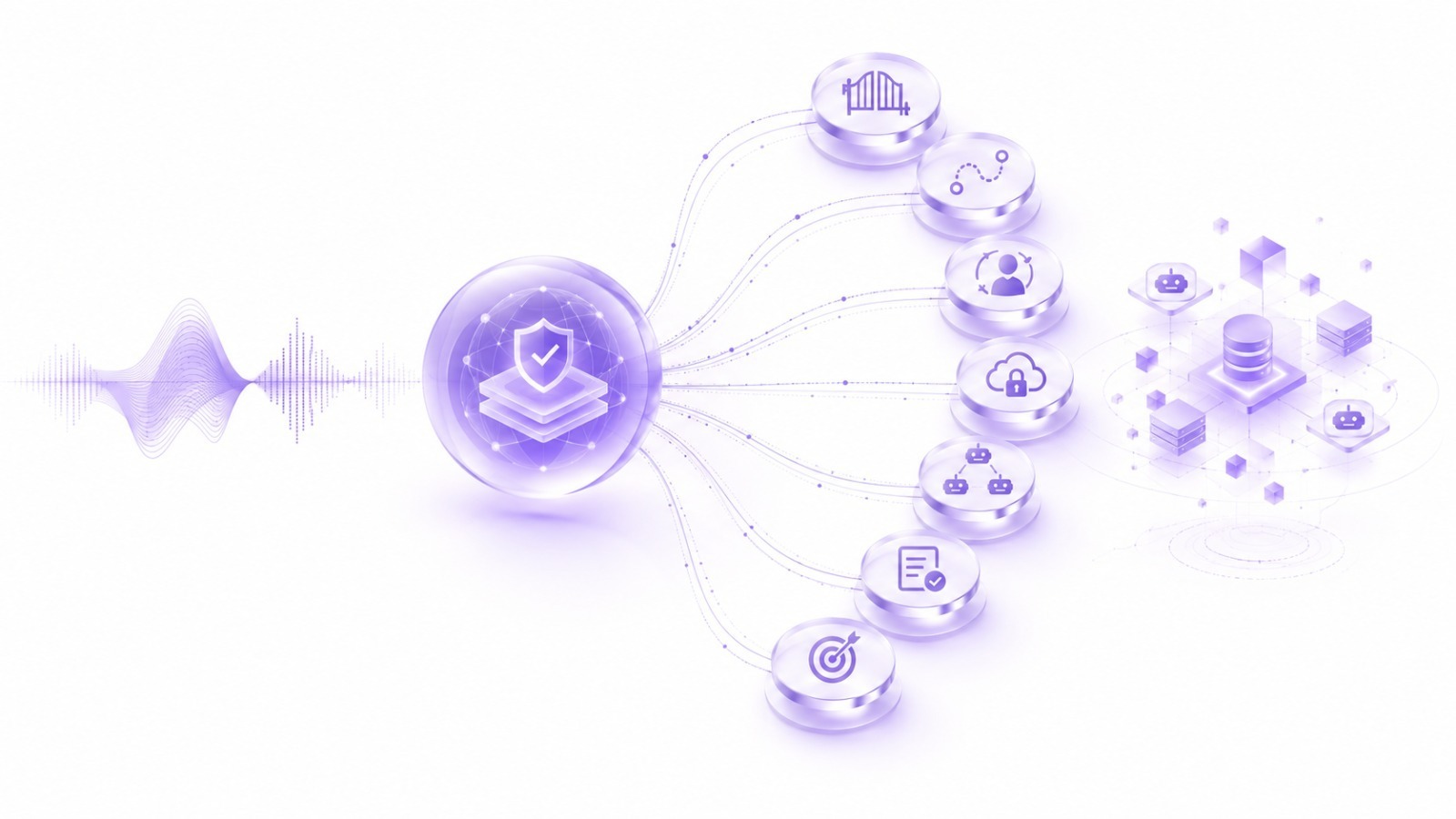

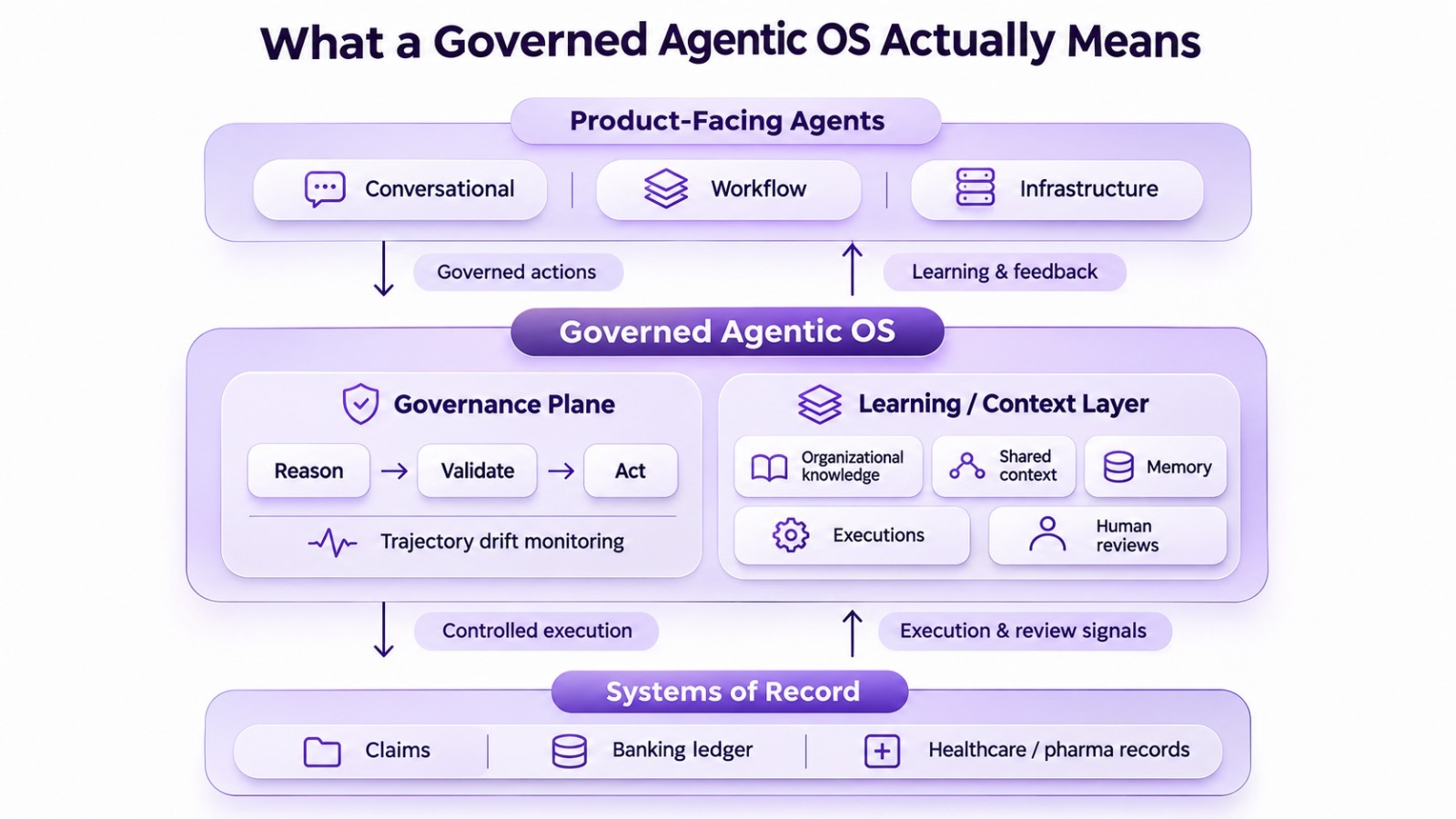
A Governed Agentic OS is the layer that allows enterprise AI agents to interact with an organization's systems of record while maintaining control over their actions, decisions, and execution processes.
An enterprise cannot run agents directly on its systems of record any more than it can run applications directly on bare hardware. It needs an operating layer in between: one that decides what an agent is allowed to do, records what it did, and feeds what it learned back into the next run.
That layer has two foundations. A governance plane that sits in front of every action (reason, validate, then act) and watches the full trajectory afterwards for drift. And a learning layer, what the market increasingly calls the context layer or context fabric, that holds what an employee would know about the organization: internal knowledge, shared context, and memory across applications. It turns every execution, every human review, and every context source into a decision trace the next agent can draw on.
The product-facing agents (conversational, workflow, infrastructure) run on top of both.
For enterprises evaluating a Governed Agentic OS, the AWS partnership and governed agentic AI deployment approach provide additional context on deploying governed AI systems within enterprise cloud environments.
Run any candidate through these seven questions. Each one exposes a place where vendors commonly cut corners, usually the exact place where a promising pilot turns into an incident report.
1. Is Every Action Gated Before It Executes, or Logged After?
Observability tells you what an agent did. Governance decides what it is allowed to do. Most "governed" platforms offer the first and call it the second: a trace viewer, an audit log, a replay. By the time anyone reads the log, the refund has been issued or the claim has been adjudicated.
The test: ask the vendor to show one agent action being intercepted, validated against policy, and blocked, live, before it reaches the downstream system. If the demo shows a log entry rather than a stopped action, you are looking at monitoring, not control.
A strong pre-action governance approach should demonstrate how agent actions are evaluated before execution rather than relying exclusively on post-execution monitoring.
2. Does It Catch Drift Across the Full Trajectory, or Only Filter Inputs and Outputs?
An agent can pass every input filter and produce a clean final output while taking a wrong turn in step four of twelve: calling the wrong tool, skipping a verification, reading stale context. Input/output guardrails never see that turn. Trajectory-level drift detection does.
The test: ask for a trajectory where the final answer looked correct but the path was wrong, and ask how the system flagged it. If the vendor can only show prompt filters and output classifiers, step-level drift will reach production unseen.
3. Does Human Review Become a Training Signal, or Disappear Into a Ticket Queue?
Every human-in-the-loop (HITL) decision is ground truth the enterprise has already paid for. In most deployments it is also wasted: a reviewer overrides the agent, the ticket closes, and the next hundred runs make the same call.
A system that compounds treats every override as a decision trace and feeds it back into the context the next run draws on, subject to appropriate validation and change controls.
The test: pick one low-confidence escalation from last week and ask the vendor to show where that reviewer's decision now lives in the system and which future run it changes. "We can export the review logs" is not an answer.
A comprehensive Agentic AI Governance Platform should provide a structured approach to decision validation, governance, and human oversight across agent executions.
4. Does It Run in Your Cloud, With Your Data Never Leaving?
For healthcare, banking, insurance, and pharma, this is not a preference. A conversational agent that routes a patient call through a vendor's inference endpoint, or a claims agent that ships documents to a hosted workflow engine, is a data-residency finding waiting for an auditor.
Deployment inside the customer's own account, on any major cloud, is the baseline.
The test: ask for the architecture diagram and trace one record from ingestion to output. Every hop should land inside infrastructure you control. Also verify any external inference, telemetry, logging, and third-party service dependencies.
5. Does Governance Extend to Agents You Did Not Buy From This Vendor?
Enterprises already run agents from three or four sources: an internal team's framework, a SaaS vendor's copilot, a hyperscaler's agent service.
A governance plane that only governs its own vendor's agents leaves most of the estate ungoverned. The useful question is whether the control plane is framework-agnostic: whether it can gate and audit any agent that emits standard telemetry.
The test: bring an agent built on a framework the vendor does not sell and ask them to put it under the same policy. If the answer requires rebuilding the agent on their stack first, the governance is a feature of their product, not an operating layer for your enterprise.
6. Does It Carry Regulatory Depth for Your Industry, or Leave Compliance Mapping to You?
A horizontal platform knows what a policy is. It does not automatically know that an adverse-event report must satisfy FDA 21 CFR Part 11 requirements for applicable electronic records and signatures, that a claim carries X12 EDI and ICD-10 structure, or that credit decisioning answers to applicable banking regulations, including Basel III.
Those mappings are where months of implementation time go, and they are where audits fail.
The test: name your two most consequential workflows and ask the vendor to show a production deployment in that regulatory regime, with the controls already encoded.
A generic policy engine plus a promise to "configure it together" means you are the one building the compliance layer.
Strong Enterprise AI Governance also requires organizations to assess security practices, privacy controls, data protection measures, and the evidence available to demonstrate compliance.
7. Is the Vendor Accountable for the Outcome, or Metering Your Usage?
Tokens, seats, and hours are measures of consumption. None of them is a measure of whether the claims backlog cleared or the collections recovery rate moved.
A platform priced on consumption has no structural reason to care whether the outcome lands; a partner priced against your KPI has a stronger commercial incentive to focus on results.
The test: ask what happens commercially if the agreed KPI is missed in the first quarter of production. The answer tells you who carries the risk of the system actually working.
The checklist is easier to apply once it sits next to what most teams already run. An agent framework, an observability tool, and a Governed Agentic OS solve different problems, and it is worth being clear about which one you are buying.
None of the first two columns is wrong to run. A framework is how agents get built; an eval tool is how they get measured. The problem shows up when a vendor sells one of those columns using the promises that only belong in the third.
A few patterns reliably signal that a "governed agentic platform" pitch is an agent framework with a dashboard attached.
The pattern underneath all four is the same: a system assembled to pass a proof of concept, with no structure for what happens after.
Gartner predicts that more than 40% of agentic AI projects will be canceled by the end of 2027, citing escalating costs, unclear business value, and inadequate risk controls (Gartner, June 2025). Inadequate risk controls and unclear business value are governance and accountability failures, not capability failures.
The same release estimates that only about 130 of the thousands of vendors claiming agentic AI offer it in substance; the rest relabel chatbots, RPA, or assistants as agents. The checklist above is how you tell the difference.
A few situations tend to show up before a team realises it has outgrown frameworks and dashboards:
If two or more of these sound familiar, run the seven questions above against whatever is already on your shortlist.
What is a Governed Agentic OS? It is the operating layer between an enterprise's AI agents and its systems of record. It gates every action before execution, detects drift across the full trajectory afterwards, and turns every execution and human review into context the next run draws on. Product agents for conversation, workflow, and infrastructure run on top of it.
How is it different from an agent framework? A framework is how agents get built. A Governed Agentic OS is what keeps agents from many frameworks, built by many teams, under one policy, one audit trail, and one learning layer. The two are complementary; the OS is what makes the framework safe to run against a ledger.
How is it different from AI observability? Observability records what happened after it happened. Governance decides what is allowed to happen and stops what is not. An observability tool is a necessary input to governance; it is not a substitute for a control plane that acts before the downstream system is touched.
Do I need one if my agents are only recommending, not acting? Less urgently, but the boundary moves faster than most teams expect. The first agent that is allowed to write to a system of record is the one that needs the control plane already in place, and retrofitting governance onto an agent estate is far more expensive than deploying agents onto a governed layer from the start.
How long does it take to see results? For a single workflow in a regulated industry, a production deployment with governance in place is a matter of weeks when the regulatory controls are already encoded, and months when they have to be built during implementation. That difference is checklist item six.
Publishing notes
The next phase of enterprise AI adoption will depend on more than increasingly capable models and autonomous agents. Organizations need an operating layer that allows agents to interact with critical business systems while maintaining control over decisions, execution, security, and accountability. A Governed Agentic OS provides an architectural foundation for this transition by bringing together pre-action governance, execution monitoring, organizational context, human feedback, and enterprise integration within a unified operating layer.
Through its approach to governed agentic AI, Aivaar focuses on helping enterprises move beyond isolated pilots toward production-ready systems that can operate, adapt, and deliver measurable business outcomes. For organizations evaluating the next generation of enterprise AI infrastructure, the important question is no longer simply whether an AI agent can perform a task, but whether it can operate within organizational policies, remain accountable for its decisions, and improve without compromising enterprise trust.
Build. Deploy. Empower. With Aivaar.
Governed Agentic OS → https://www.aivar.tech/partner-aws
Agentic AI Governance Platform → https://www.aivar.tech/partner-anthropic
Enterprise AI Governance → https://www.aivar.tech/trust-center
Pre-action governance → https://www.aivar.tech/blog-posts/building-multi-agent-ai-systems-on-aws-bedrock-with-convogent
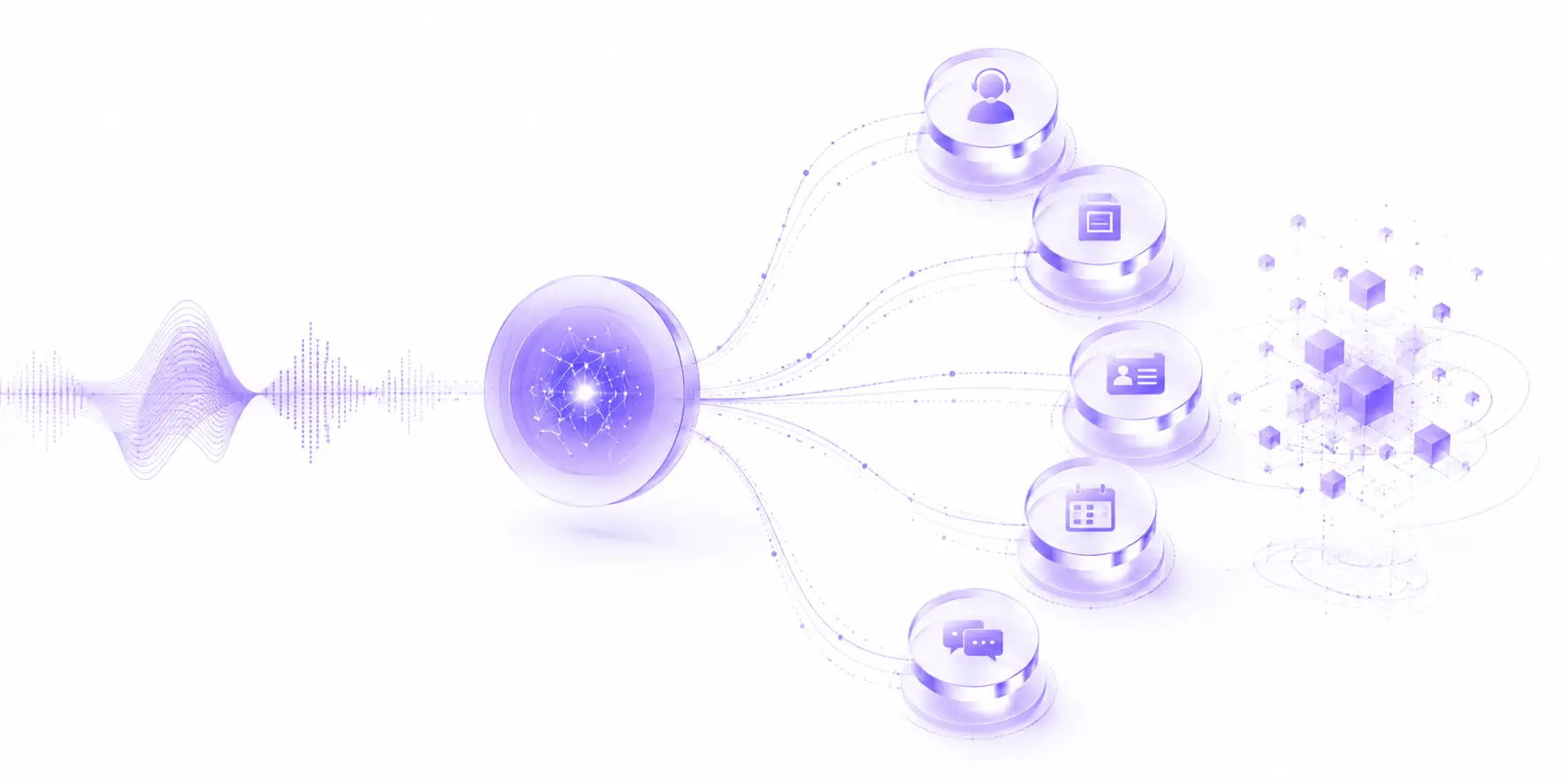
Convogent, Aivar's multi-channel conversational intelligence platform, runs voice interactions at sub-500 millisecond latency when a turn needs no backend call and under 1.2 seconds when it does, while holding more than 1,000 concurrent sessions in validated deployments. AWS Marketplace lists Convogent as an implementation service that designs and deploys "AI voice bots powered by Amazon Bedrock" directly inside a customer's own AWS account, across more than 100 languages. That deployment model, one AWS account per customer with data that never crosses into Aivar's infrastructure, is the constraint that shaped how we built Convogent's agent graph on top of Bedrock rather than around it.


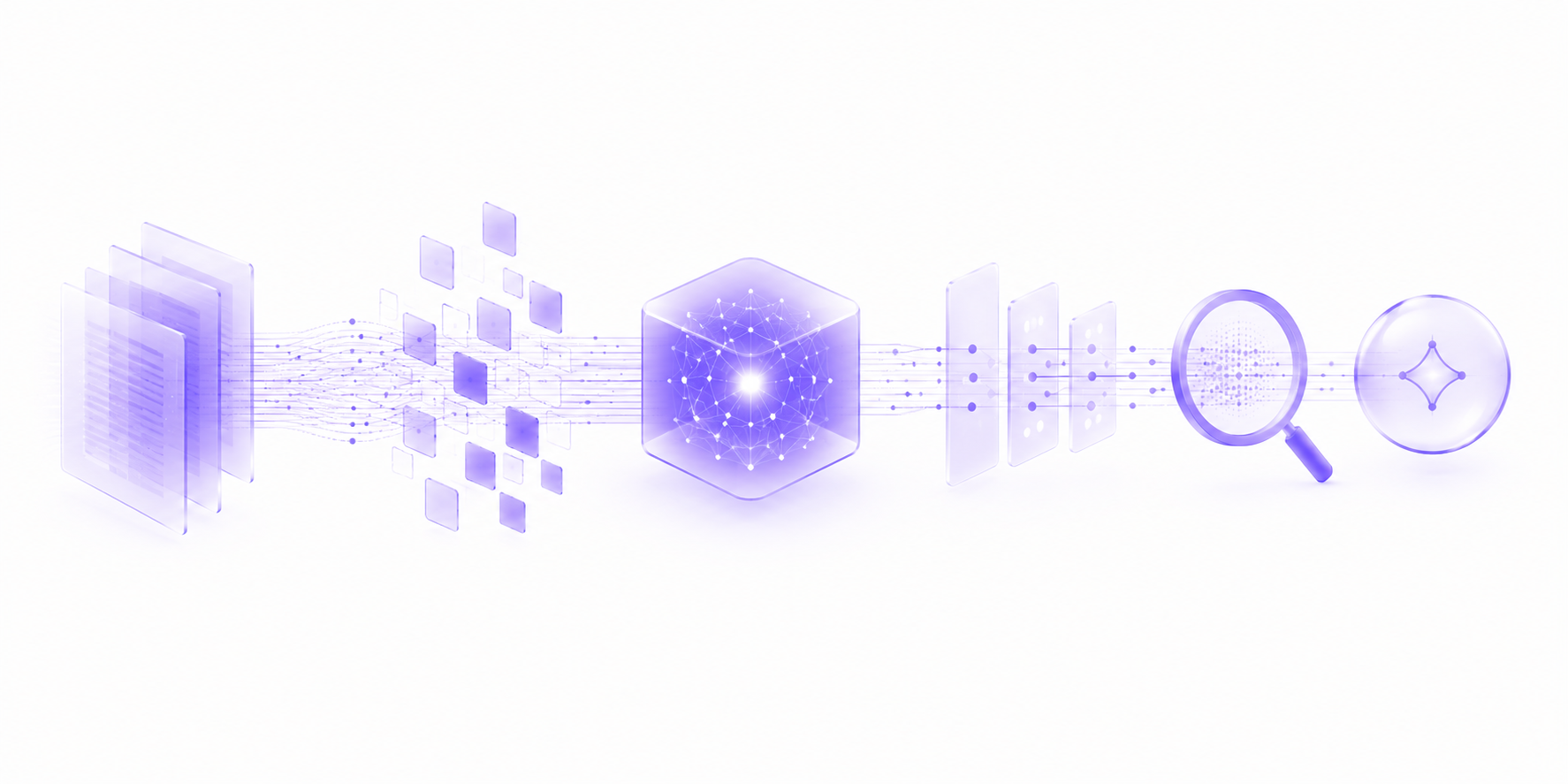
Naive RAG pipelines, embed a document, store the vector, retrieve top-k by cosine similarity, generate, fail at retrieval roughly 40% of the time in production, according to a 2026 production guide covering deployments across enterprise knowledge bases. The failure mode is not a crash. It is a fluent, well-structured answer grounded in the wrong passage, which is worse than an outright error because customers trust it. On AWS, three decisions determine whether a retrieval-augmented generation system crosses that 40% line or stays on the safe side of it: how documents get chunked, which vector store holds the embeddings, and whether retrieval runs single-pass or hybrid-plus-rerank.