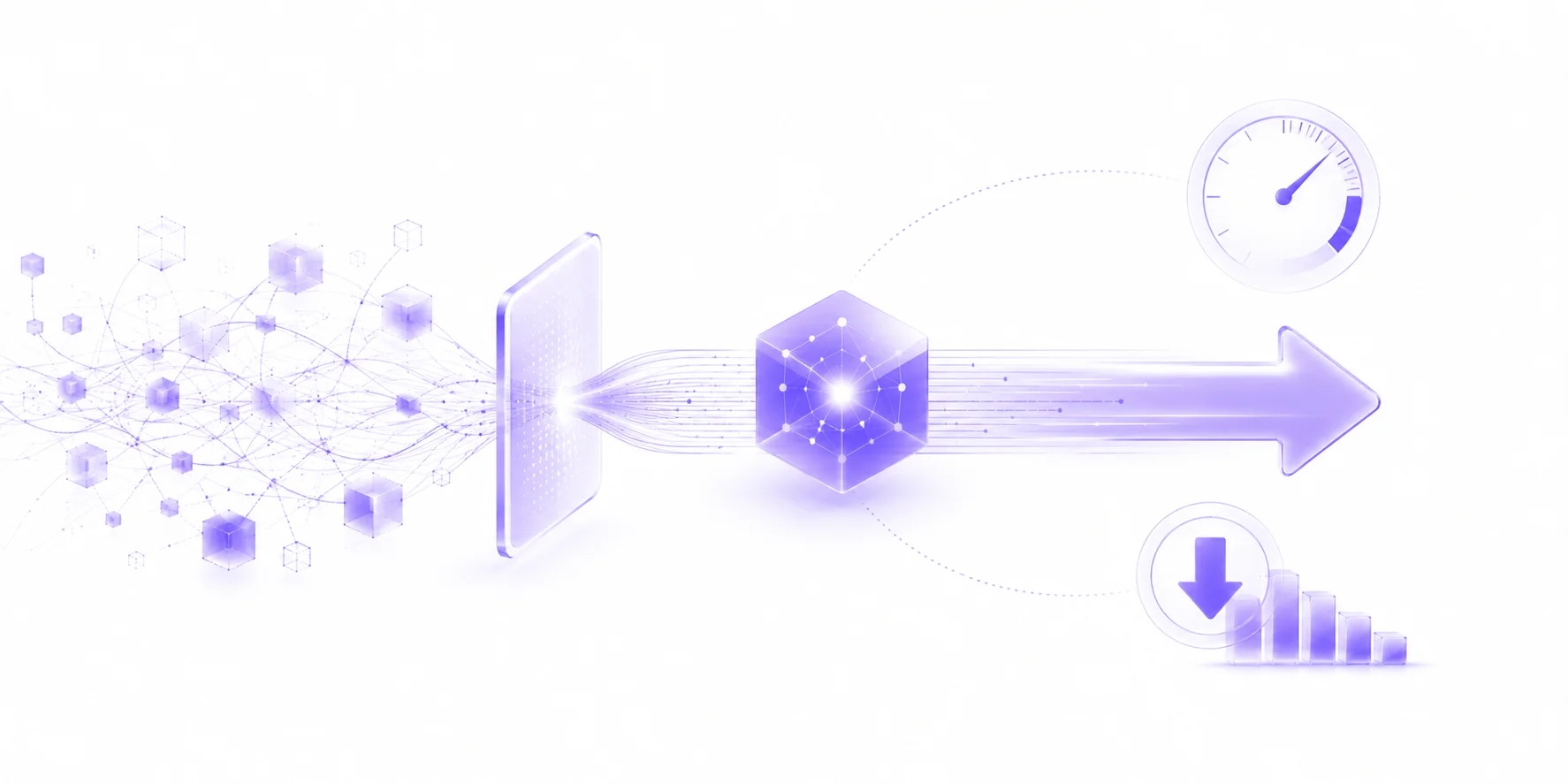
The gap between those two numbers is not a model problem. It is an integration problem, and it determines whether your team spends the next two quarters wiring APIs or shipping outcomes.

Sixty-three percent of organizations exceed their original AI project timeline, most commonly because they underestimated data readiness and integration work, not model quality (KPMG Enterprise AI Adoption Report, 2024). One Fortune 500 manufacturer confirmed where that time goes: connecting AI agents to existing planning systems consumed up to six months of custom API development per project (AWS Partner Network Blog, 2026). When that same manufacturer replaced dozens of point-to-point integrations with a single standardized interface on Amazon Bedrock AgentCore, deployment time for one agent dropped from 12 weeks to 3 days. Your engineering team is not slow because generative AI is hard to configure. It is slow because every custom deployment rebuilds authentication, orchestration, and monitoring from a blank AWS account, work a packaged accelerator has already done once and reuses on every subsequent customer.
Nearly two-thirds of organizations remain stuck running pilots that never scale past a single team or use case (McKinsey State of AI, 2025). Only 8.6% of companies currently have AI running in production despite near-universal tool access, and that gap between access and production is exactly where mid-market programmes stall (2026 enterprise benchmarks, cited in AI Assembly Lines). The direct cost compounds by channel: Gartner projects conversational AI will cut global contact-center labor costs by $80 billion in 2026 alone. That money keeps flowing to a live headcount line for every quarter a voice deployment slips. The organizational cost compounds too. Ops and IT staff spend that stalled quarter firefighting integration tickets instead of building the next use case. The sponsor who championed the original pilot loses the internal credibility needed to fund a second one.
A packaged AWS-native accelerator does not replace your AI strategy. It replaces the plumbing your team would otherwise build from scratch: AWS Bedrock connections, the authentication layer, observability hooks, and the guardrails that keep an agent from acting outside its lane. Convogent, a multilingual conversational and voice accelerator, routes a single customer conversation across specialist agents and model providers without forcing every interaction into one rigid script. Velogent, its agentic-workflow counterpart, targets regulated, document-heavy processes such as invoice matching and contract reconciliation, where a wrong automated decision has compliance consequences. At one of Aivar's customers, a logistics SaaS firm, three-way invoice matching moved to an 80% reduction in reconciliation effort within six to eight weeks, using a Velogent deployment on AWS. Because the underlying accelerator IP was already built and validated, the same customer's next two workflow deployments shipped in two to three weeks each, not six to eight (YourStory, 2026). That compounding curve, not the first project alone, is what separates an accelerator from a one-off consulting engagement.
A packaged accelerator compresses the integration layer, not the judgment layer. Regulated workflows still need a compliance review of what the agent is allowed to decide unattended, and voice deployments still need call-flow design specific to your customers' language and intent patterns. Mid-market teams that skip this step and expect an out-of-the-box agent to match their exact process on day one typically extend their own timeline back toward the 12-month baseline they were trying to avoid.
Your CFO gets a cost curve that starts moving in the same quarter as the deployment, not eighteen months later. Payback periods for accelerator-based voice deployments run under six months, against a three-year ROI of 331% to 391% for enterprises running production voice AI (Forrester Consulting, cited in Ringly.io, 2026). Your ops lead stops triaging integration tickets and starts triaging exceptions the agent correctly escalated, which is a materially smaller and more specialized queue. Your IT team keeps ownership of the deployed environment rather than depending on an external vendor for every change, because the accelerator ships as infrastructure inside your own AWS account, not a black-box SaaS subscription.
The real choice mid-market leaders face is not whether to build AI in-house or buy a point solution. It is whether to keep re-solving integration problems that AWS-native accelerators have already solved once, validated across dozens of deployments, and made reusable. Every quarter spent rebuilding that plumbing internally is a quarter a competitor spends shipping the next use case on top of infrastructure that already exists. If your team is scoping a first AI programme and the 12-month timeline is already the assumption in the room, that assumption is worth re-checking before the budget gets locked in. Aivar's team can walk through where a packaged accelerator fits your specific workflow at aivar.tech/contact-us.
Mid-market AI programmes stall for a predictable reason: custom integration work eats the timeline before the model ever gets evaluated on the actual business problem. Packaged, AWS-native accelerators such as Convogent and Velogent remove that integration layer and replace it with infrastructure that has already shipped and been validated elsewhere. The result, documented in a real deployment, was an 80% cut in manual effort inside eight weeks, with follow-on work compressing further. That is the number worth holding your next AI vendor conversation against.
How Long Does AI Transformation Take? Mid-Market Timeline Guide — Phase-by-phase mid-market AI transformation timelines.
Enterprise AI Implementation Cost, Timeline & Framework (2026) — 12-18 month baseline for a focused first AI implementation.
Accelerating supply chain AI with Kinaxis MCP on Amazon Bedrock AgentCore — Integration bottleneck data and the 12-week-to-3-day case.
AI Voice Agent Statistics 2026 — Forrester ROI and payback-period figures for enterprise voice AI.
Realizing AI for global enterprises with Aivar — Bessemer Venture Partners on Aivar's productized accelerators and delivery speed.
AI startup Aivar raises $4.6M, aims to turn AI experiments into production-ready enterprise solutions — Documented Velogent invoice-matching case study and timeline compression.

Convogent, Aivar's multi-channel conversational intelligence platform, runs voice interactions at sub-500 millisecond latency when a turn needs no backend call and under 1.2 seconds when it does, while holding more than 1,000 concurrent sessions in validated deployments. AWS Marketplace lists Convogent as an implementation service that designs and deploys "AI voice bots powered by Amazon Bedrock" directly inside a customer's own AWS account, across more than 100 languages. That deployment model, one AWS account per customer with data that never crosses into Aivar's infrastructure, is the constraint that shaped how we built Convogent's agent graph on top of Bedrock rather than around it.



Naive RAG pipelines, embed a document, store the vector, retrieve top-k by cosine similarity, generate, fail at retrieval roughly 40% of the time in production, according to a 2026 production guide covering deployments across enterprise knowledge bases. The failure mode is not a crash. It is a fluent, well-structured answer grounded in the wrong passage, which is worse than an outright error because customers trust it. On AWS, three decisions determine whether a retrieval-augmented generation system crosses that 40% line or stays on the safe side of it: how documents get chunked, which vector store holds the embeddings, and whether retrieval runs single-pass or hybrid-plus-rerank.







.svg)
.svg)
.svg)
.svg)

.svg)