
The second failure is newer, quieter, and more dangerous: over-trust. Agentic AI doesn't just draft documents, it becomes a system of record. When adoption succeeds too well, teams start accepting AI output at scale, oversight lapses, and a mistake that would once have been one bad email becomes a bad entry in a financial system, a customer record, or a regulatory filing. Nobody notices anything, until it compounds.
Here's the uncomfortable truth: the harder you push against the first failure, the more exposed you are to the second. Adoption programs that maximize enthusiasm without engineering oversight are simply trading one failure mode for the other.
TRACE is a framework Aivar built to prevent both at once. Five stages (Trust, Route, Adopt, Calibrate, Evolve) running on a continuous zero-trust governance spine. It is the same model whether you're governing a single pilot in one function or a full enterprise rollout across thousands of users. Only the scale changes.
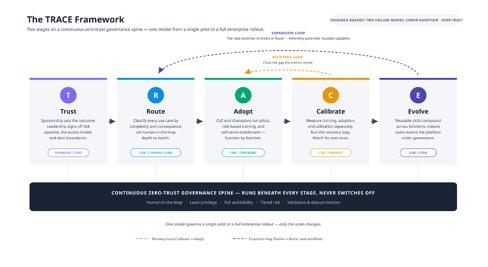
Figure 1. The TRACE framework: five stages on a continuous zero-trust governance spine, with the recovery loop (Calibrate → Adopt) and the expansion loop (Evolve → Route).
Frameworks are easy to nod along to and hard to picture. So let's run one real problem through all five stages.

Pick almost any enterprise (manufacturer, hospital system, bank, retailer) and somewhere inside it sits an accounts payable team drowning in invoice exceptions.
The happy path is automated already: invoice arrives, matches the purchase order and the goods receipt, posts to the ERP, gets paid. But 15–30% of invoices fall out of that path: price mismatches, quantity variances, missing PO references, duplicate submissions, new vendors, currency issues, suspected fraud. Each exception becomes a human investigation: pull the PO, chase the buyer, email the vendor, check the vendor master, approve or reject, then post, short-pay, or reject — then post the resolution to the ERP.
It's a deep enterprise problem for three reasons. It's high-volume (thousands of exceptions a month at scale). It's consequential: every resolution moves real money and touches the financial system of record, with fraud, duplicate-payment, and audit exposure attached. And it's knowledge-intensive — resolving an exception requires context scattered across the ERP, procurement systems, contracts, and email threads.
It's also a perfect illustration of both failure modes. Deploy an AI copilot for AP and change nothing else. If the clerks ignore it, you’ve got under-adoption. Deploy an agent that resolves exceptions autonomously and let vigilance fade, and one day it approves a convincing fraudulent invoice at 2 a.m. — over-trust. Now let's watch TRACE handle it.
T — Trust: sponsorship sets the outcome
How it's usually done: an innovation team or a vendor runs an AP automation pilot. Security and internal audit hear about it when it's time to go to production, at which point the access review starts from scratch, the pilot's assumptions get re-litigated, and momentum dies in committee. Alternatively, nobody defines an outcome at all, and the pilot's success metric quietly becomes “people seemed to like it.”
How TRACE does it: before a single exception is touched, the CFO (sponsor) defines the outcome — say, cut exception resolution time from 9 days to 2, reduce duplicate payments by 90%, with zero increase in fraud losses. Leadership and the CISO then sign off on three things: risk appetite (the agent may resolve exceptions, but a human approves anything that releases payment above a threshold), the access model (read access to the ERP and procurement systems; write access only to a staging queue, never directly to payment runs), and data boundaries (vendor banking details visible to the validation step but never surfaced in agent outputs or logs).
The difference is not paperwork. It's that when the pilot works, the path to production is already agreed, because the people who could block it designed the boundaries on day one.
Owner: Sponsor / CISO
R — Route: match oversight to consequence
How it's usually done: one policy for everything. Either every AI action needs approval (so resolving a $40 freight-charge variance takes as many clicks as approving a $400,000 invoice, and users abandon the tool) or the agent is trusted uniformly (and the $400,000 decision gets the same scrutiny as the $40 one.).
How TRACE does it: the AP exception universe is classified along two axes i.e. complexity and consequence, and human-in-the-loop depth is set per tier:
• Low tier: small-value price variances within contract tolerance, missing PO references the agent can resolve from context. The agent resolves and posts autonomously; humans review a daily sample.
• Medium tier: variances above tolerance, first-time vendor invoices, short-payment recommendations. The agent prepares the full resolution with evidence, and a clerk approves with one click or edits.
• High tier: anything touching vendor banking details, suspected duplicates or fraud, invoices above the payment threshold. Mandatory human decision, agent provides analysis only, second-level review on approval.
The routing is what makes the economics work. Roughly 60% of exception volume typically lands in the low tier. That's where the speed comes from. The 5% in the high tier is where the losses live — that's where the oversight goes. Uniform policies get you neither.
Owner: Center of Excellence / Change Lead
A — Adopt: function by function, not big bang
How it's usually done: a global rollout announcement, a one-hour generic training webinar, and a launch email. Three weeks later, the AP team in one region uses it heavily, two regions never log in, and nobody knows why. Champions were appointed, not grown. training covered the tool, not the job.
How TRACE does it: start with one exception type in one region (say, price-variance exceptions in North America) run by the Center of Excellence with a champion drawn from the AP team itself, someone who has worked the queue. Training is role-based: clerks learn how to review and correct agent resolutions; the AP manager learns the tier dashboard and escalation flow; internal audit learns how to read the decision trail. Self-serve enablement lets the strong performers extend to new exception types ahead of the formal schedule.
When price variances in North America hit the outcome metrics, the results (cycle time, catch rate, clerk feedback) become the pitch to the next region. Adoption gets pulled by proof, not pushed by mandate. The same pattern then extends beyond AP: the CoE takes the playbook to order-to-cash disputes, then customer onboarding, each function inheriting the discipline.
Owner: CoE / Training
C — Calibrate: measure three things separately
How it's usually done: one metric, usage, reported monthly. “Adoption is at 70%” tells leadership nothing about whether value is landing, and nothing at all about whether oversight is decaying.
How TRACE does it: three measurements, kept deliberately separate, because they diagnose different diseases:
• Training completion — do AP clerks know how to work with the agent? If this is high but adoption is low, the problem is workflow fit or motivation, not knowledge.
• Adoption — are exceptions actually flowing through the agent, or are clerks quietly working the old queue? High training with low adoption in one region is a management conversation, not a training rerun.
• Utilization — is the agent being used on the exception types it was routed for, or only on the trivial ones? High adoption with low utilization means the team uses it to clear easy freight variances while the duplicate-detection capability — where the money is — sits idle.
Each gap triggers a recovery loop: a structured intervention with an owner and a date, not a shrug in a steering committee.
And Calibrate is where over-trust gets caught early, because you're watching for its signature: medium-tier approval rates drifting toward 100%, review time per exception shrinking from ninety seconds to four, high-tier escalations that stop happening. In the traditional approach, those signals aren't measured, so the first sign of over-trust is a loss event. In TRACE, they're on the same dashboard as the adoption numbers: the two failure modes monitored in one place.
Owner: CoE / Function Owners
E — Evolve: compound what works
How it's usually done: the AP automation succeeds and becomes an island. The order-to-cash team, facing a structurally similar problem, starts its own project from zero: new vendor evaluation, new governance debate, new pilot. The enterprise accumulates disconnected point solutions, each with its own controls, none learning from the others.
How TRACE does it: what the AP rollout hardened i.e. the three-way-match reasoning, the vendor-verification workflow, the tiering logic, the evidence-trail format that satisfied internal audit — becomes a library of reusable, governed capability. When order-to-cash disputes come next, the team inherits the duplicate-detection skill, the escalation patterns, and a governance template already blessed by the CISO. Mature users in the AP team start extending the platform themselves (new exception types, refined tolerance rules) under governance, with the CoE curating and the CISO ensuring extension never outruns control.
This is where the economics turn. The second workflow costs a fraction of the first; the tenth costs a fraction of the second. The organization's AI capability starts compounding rather than merely accumulating.
Owner: CoE / CISO
The stages are sequential; the governance spine is continuous. Five control principles run beneath every stage, at every scale — visible in the AP example throughout:
1. Human-in-the-loop — the agent drafts and recommends; a human approves any change to a system of record, with depth set by the Route tier. No payment releases without the tier's required approval.
2. Least privilege — role-based access, SSO, no standing write access. The agent reads the ERP; it writes only to its staging queue.
3. Full auditability — every exception resolution logged with its evidence and reasoning. When the auditors ask why invoice #48213 was short-paid, the answer takes seconds, not archaeology.
4. Tiered risk — low, medium, high, with progressively stronger review, so governance intensity always matches consequence.
5. Validation and data protection — resolutions checked before they post; vendor banking data bounded by design, not by policy memo.
The spine is what makes TRACE different from a change-management program with a security appendix. The controls aren't a phase you graduate from, but are the rails the entire adoption journey runs on. That's also why the same model governs a ten-person pilot and a ten-thousand-user rollout: the rails don't change, only the length of the track.
If you're a CXO sponsoring an AI program, TRACE gives you a simple test for any adoption plan put in front of you: does it address both failure modes? If the plan is all enthusiasm and enablement, ask where over-trust gets caught. If it's all controls and committees, ask where adoption actually happens.
If you run a Center of Excellence, the two mechanisms that do most of the work are consequence-based tiering in Route and the three-metric discipline in Calibrate. Start there, with one workflow (your equivalent of invoice exceptions) and let Evolve do the compounding.
And if you're evaluating the broader market: the companies that win enterprise AI will not be the ones with the most capable models. They will be the ones that make adoption safe enough to scale, and scaled enough to matter. Capability is table stakes. Governed adoption is the moat.
At Aivar, TRACE is how we run enterprise AI adoption with our customers. It’s the the change-management counterpart to our Governed Agentic OS, where ReVAct operationalises the governance spine and Aiva compounds what every stage learns. If you're working through an adoption program and want to compare notes, we'd value the conversation: aivar.tech.

Convogent, Aivar's multi-channel conversational intelligence platform, runs voice interactions at sub-500 millisecond latency when a turn needs no backend call and under 1.2 seconds when it does, while holding more than 1,000 concurrent sessions in validated deployments. AWS Marketplace lists Convogent as an implementation service that designs and deploys "AI voice bots powered by Amazon Bedrock" directly inside a customer's own AWS account, across more than 100 languages. That deployment model, one AWS account per customer with data that never crosses into Aivar's infrastructure, is the constraint that shaped how we built Convogent's agent graph on top of Bedrock rather than around it.



Naive RAG pipelines, embed a document, store the vector, retrieve top-k by cosine similarity, generate, fail at retrieval roughly 40% of the time in production, according to a 2026 production guide covering deployments across enterprise knowledge bases. The failure mode is not a crash. It is a fluent, well-structured answer grounded in the wrong passage, which is worse than an outright error because customers trust it. On AWS, three decisions determine whether a retrieval-augmented generation system crosses that 40% line or stays on the safe side of it: how documents get chunked, which vector store holds the embeddings, and whether retrieval runs single-pass or hybrid-plus-rerank.







.svg)
.svg)
.svg)
.svg)

.svg)